Net anthropogenic nitrogen input intensity in China from 2012 to 2023: Spatiotemporal evolution, regional differences, and reduction strategies
, , , , , , , ,
a State Key Laboratory of Efficient Utilization of Arable Land in Northern China, Key Laboratory of Non-point Source Pollution Control, Ministry of Agriculture and Rural Affairs, Institute of Agricultural Resources and Regional Planning, Chinese Academy of Agricultural Sciences, Beijing, 100081, China
b Bioeconomy Science Institute, Hamilton, 3240, New Zealand
Abstract
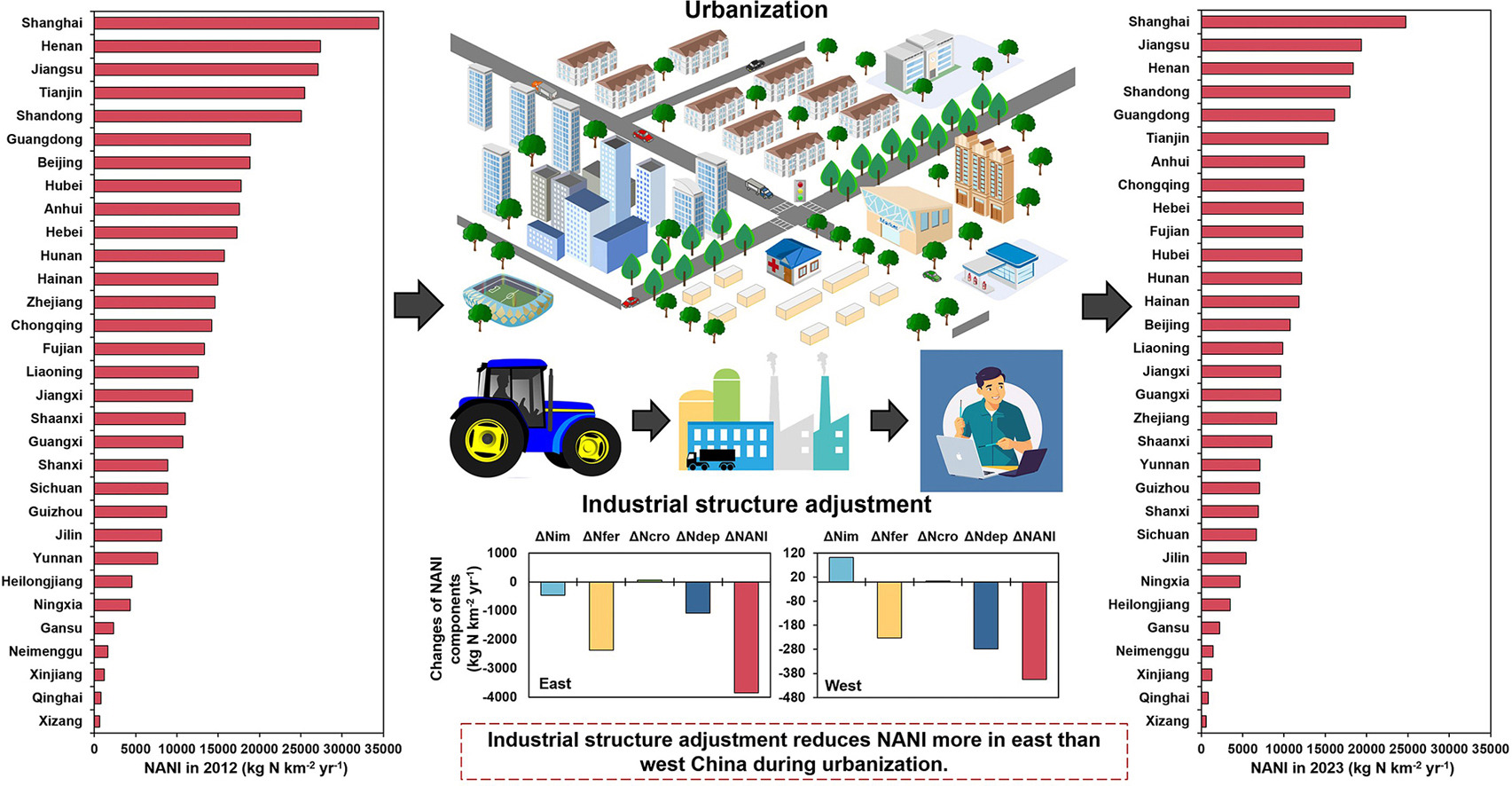
Understanding the spatiotemporal dynamics and socioeconomic associations of net anthropogenic nitrogen input (NANI) is crucial for reducing nitrogen pollution in rapidly developing economies. Based on socioeconomic data from 31 provincial-level administrative regions in China from 2012 to 2023, this study investigates the spatiotemporal variation and components of NANI and explores their associations with socioeconomic factors, with particular emphasis on the differentiated roles of urbanization, economic growth, and industrial restructuring between eastern and western regions. Temporally, national NANI ranged from 5067 to 6465 kg N km−2 yr−1 (annual mean: 5773 kg N km−2 yr−1) and decreased by 22% during the study period. Nitrogen fertilizer application (Nfer) remained the dominant component (39%), but its sharp reduction (decreasing by 33% during the study period) contributed most to the overall decline in NANI, followed by atmospheric deposition (decreased by 29%). Spatially, NANI exhibited a “high in the east and low in the west” pattern. The larger decline in NANI in eastern China was accompanied by a substantial reduction in Nfer. Partial least squares path modeling (PLS-PM) further suggested that industrial structure adjustment showed a stronger negative association with NANI than economic growth in eastern China, whereas NANI in western China was more closely associated with economic development. These findings suggest that NANI reduction benefits from region-specific strategies, with greater emphasis on fertilizer use efficiency and agricultural management in western China, and continued industrial restructuring together with nitrogen-efficient production systems in eastern China.



 Address: No. 31 Fukang Road, Nankai District,Tianjin, 300191, P.R. China
 Website: https://aepi.caas.cn/en/
 Email: hbskjc@163.com