Selecting effective adsorbents for water purification: Analysis of adsorption isotherms of substances relevant to the agricultural environment
, , , ,
Instituto de Química del Sur (INQUISUR-CONICET). Departamento de Química, Universidad Nacional del Sur, Bahía Blanca, Argentina
Abstract
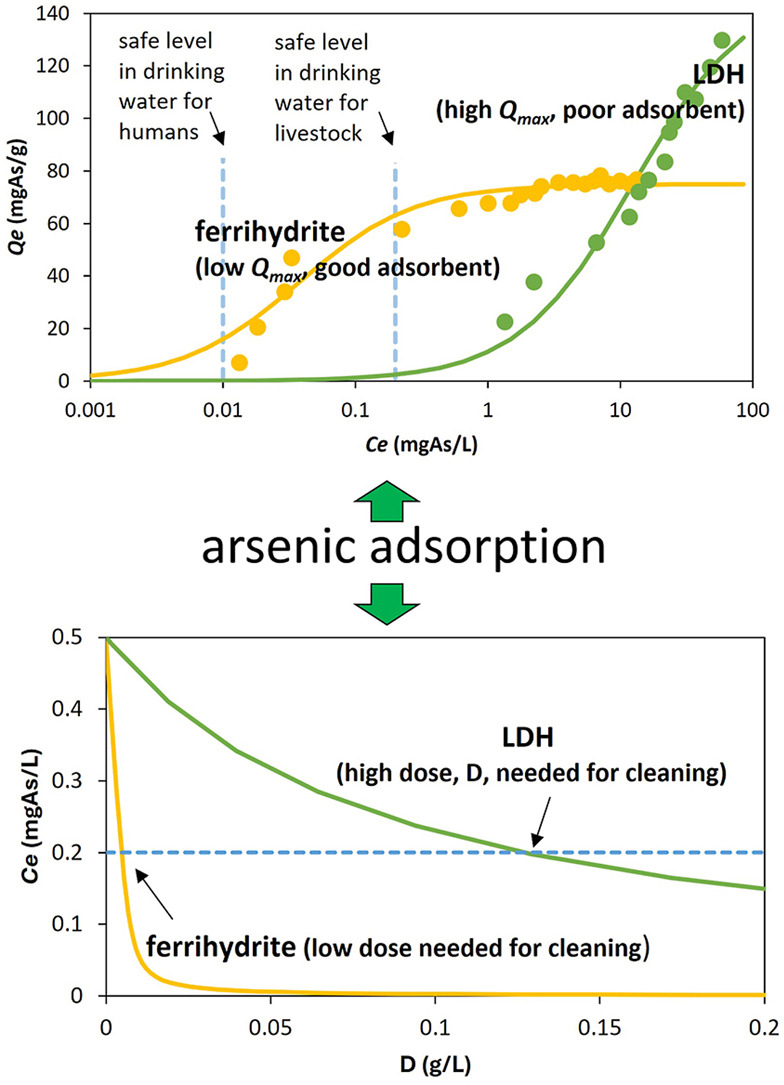
Cleaning and purifying water in agricultural environments is crucial to prevent harmful pollutants and to ensure long-term sustainability of agriculture. Among the various technologies available for purifying water in agricultural contexts, filtration with adsorbing materials is widely applied. However, there are no clear criteria for selecting an effective adsorbent, and most researchers rely on either the maximum adsorption capacity (Qmax) or the adsorption percentage to evaluate performance. This paper presents a thorough analysis of adsorption isotherms of three agriculturally relevant chemicals—paraquat, arsenate and phosphate—on a variety of adsorbents often described as excellent cleaning agents. The results clearly demonstrate that neither Qmax nor adsorption percentage are reliable parameters for evaluating adsorbent performance. Instead, the critical factor is the target residual concentration in solution. We propose straightforward equations that allow the calculation, from isotherm parameters, of the adsorbent dose (D) required to reduce pollutant concentration to the target level. This parameter provides a direct and practical criterion for identifying the most suitable adsorbent, which we illustrate with clear examples. For paraquat (PQ), a modified rice husk exhibits a higher Qmax (293 mg/g) than a montmorillonite (115 mg/g), yet requires a much larger dose (1.72 g/L vs. 0.0083 g/L) to lower pesticide concentration from 0.5 mg/L to 0.02 mg/L, demonstrating superior performance of montmorillonite. Similar patterns are observed for arsenate and phosphate, where ferrihydrite outperforms layered double hydroxides (LDHs). Although the overall adsorption extent on LDH is nearly double that of ferrihydrite, the latter proves far more efficient at agriculturally relevant concentrations.



 Address: No. 31 Fukang Road, Nankai District,Tianjin, 300191, P.R. China
 Website: https://aepi.caas.cn/en/
 Email: hbskjc@163.com