Crop diversification in Nepal (1990–2022): Policies, practices, and pathways forward
, , , , ,
a Sustainable Agrifood Systems (SAS) Asia Program, International Maize and Wheat Improvement Centre (CIMMYT), Kathmandu, Nepal
b Sustainable Agrifood Systems (SAS) Asia Program, International Maize and Wheat Improvement Centre (CIMMYT), Dhaka, Bangladesh
c Institute for Integrated Development Studies (IIDS), Kathmandu, Nepal
d International Food Policy Research Institute (IFPRI), New Delhi, India
e Ministry of Industry, Agriculture and Cooperatives (MoIAC), Biratnagar, Koshi Province, Nepal
Abstract
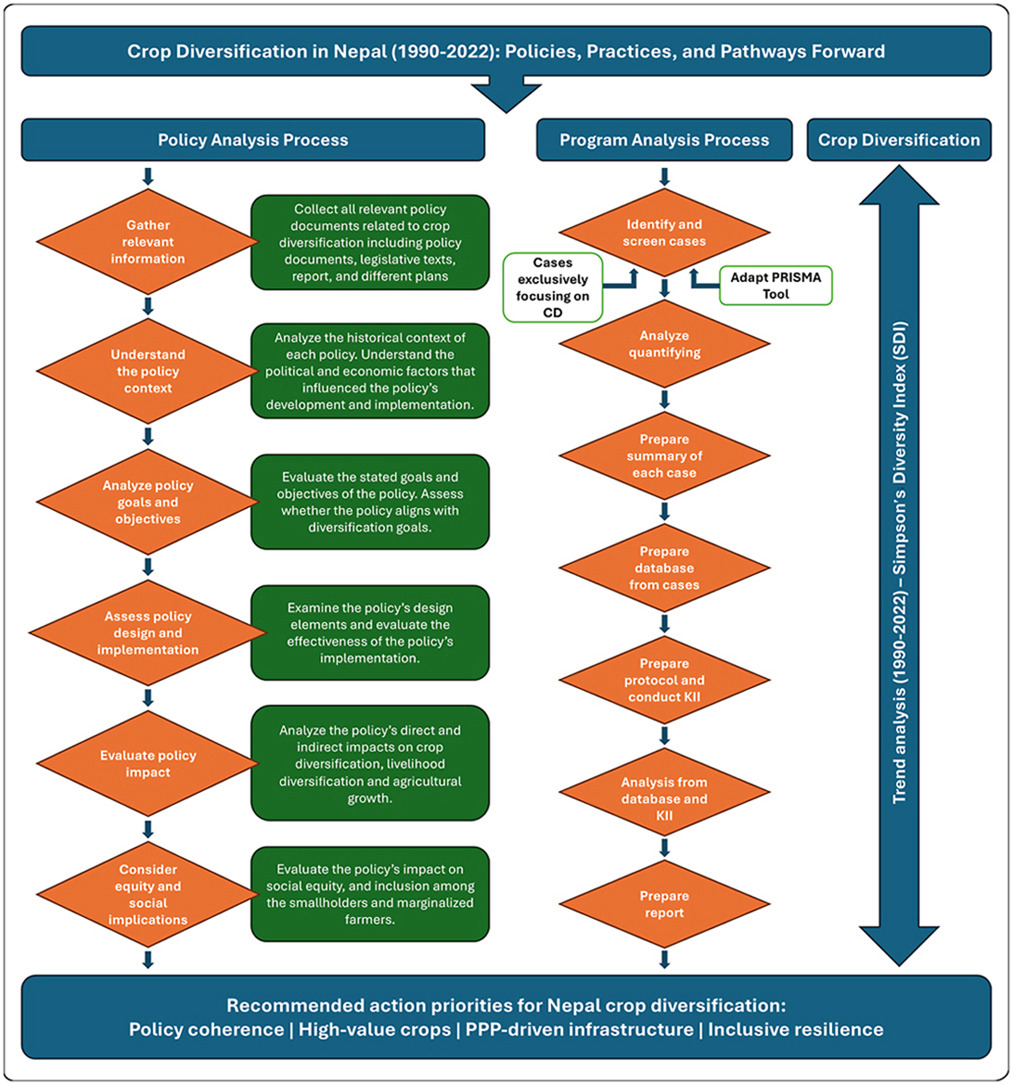
Nepal's agriculture remains predominantly cereal-based, with rice occupying most of the cultivated area and forming the dietary staple. This dependence heightens vulnerability to climate shocks, market volatility, and nutritional imbalance. Despite long-standing policy commitments to crop diversification, evidence on progress and policy effectiveness remains limited and fragmented. This study systematically reviews agricultural policies to investigate the evolution of crop diversification in Nepal, evaluate the programs to promote crop diversification, and empirically assesses diversification trends from 1990 to 2024, highlighting key gaps and structural constraints. We used a mixed-methods approach. A systematic scoping review following the PRISMA (Preferred Reporting Items for Systematic Reviews and Meta-Analyses) framework analyzed 15 periodic plans, 18 sectoral policies, and initially over 70 donor-funded projects. After screening, 23 programs were included for detailed analysis from 1956 to 2024. Complementarily, quantitative analysis using Simpson's Diversity Index (SDI) measured diversification trends over 32 years (1990–2022). SDI was also mapped district-wise for visual analysis of the changes in diversification over the past three decades. The systematic review recognizes that policies and programs have endorsed crop diversification as a strategy to enhance agricultural output, promote ecological balance and strengthen socio-economic resilience. Persistent challenges such as weak market linkages, poor storage and cold-chain infrastructure, quality assurance gaps, and fragmented value chains have constrained impact. Structural issues such as declining public investment, climate risks, and labor migration further impede progress. The quantitative analysis shows a modest increase in crop diversification over the past three decades, with a noticeable slowdown after 2015. This study provides the first longitudinal assessment linking policy evolution with diversification outcomes, emphasizing the need for integrated, value chain–oriented, and climate-resilient diversification strategies.



 Address: No. 31 Fukang Road, Nankai District,Tianjin, 300191, P.R. China
 Website: https://aepi.caas.cn/en/
 Email: hbskjc@163.com