a Department of Soil Science, University of Manitoba, Winnipeg, Canada
b Department of Microbiology, University of Manitoba, Winnipeg, Canada
Abstract
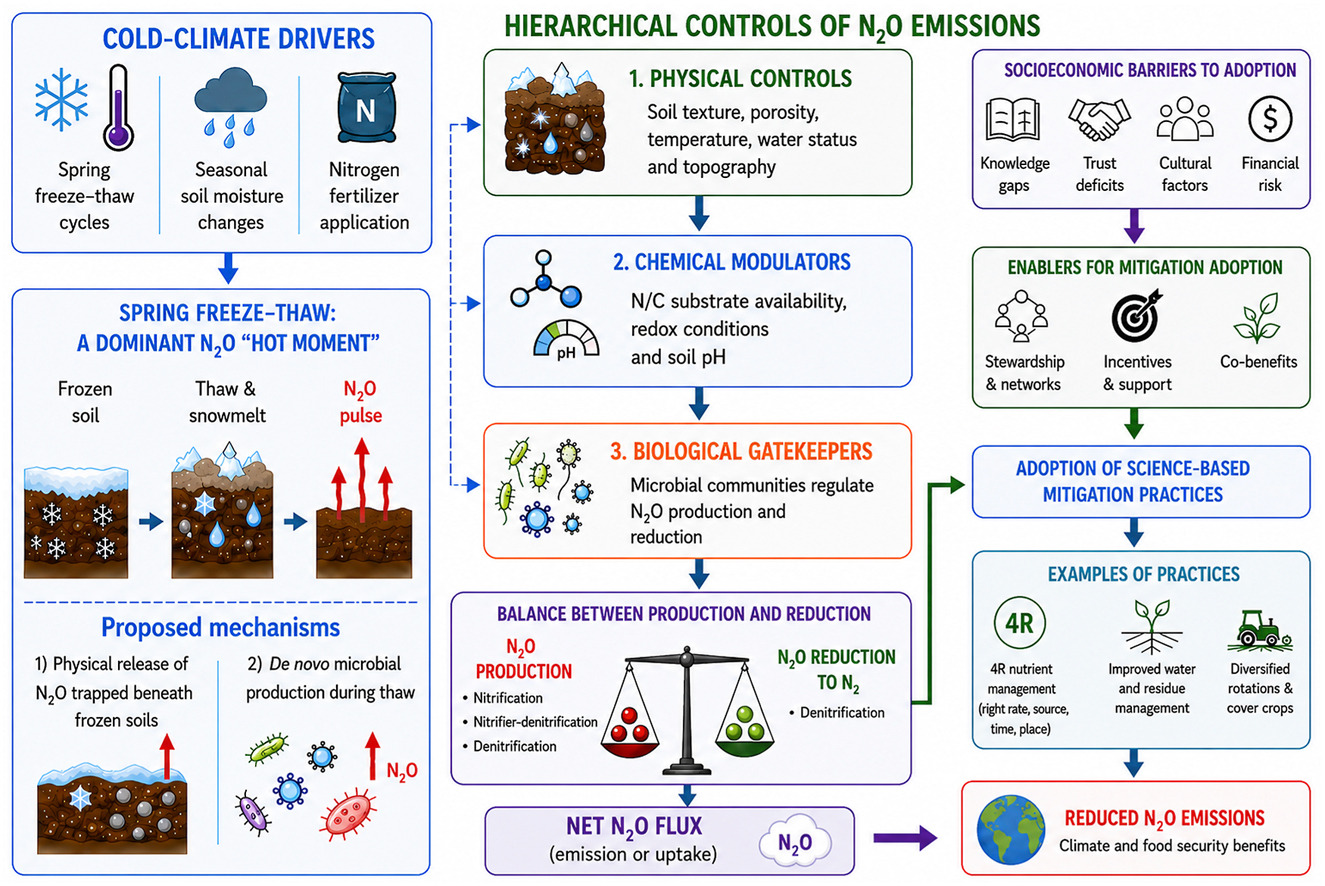
Agricultural nitrous oxide (N2O) emissions represent a key challenge at the intersection of climate change, food security, and sustainable land use. In cold-climate agricultural systems, freeze–thaw cycles, seasonal soil moisture changes, and nitrogen-intensive cropping create emission patterns that differ fundamentally from those of temperate and tropical agricultural systems, yet these distinctions are rarely captured in unified frameworks. In Canada, where agriculture contributes approximately two-thirds of national N2O emissions, a persistent gap remains between scientific understanding of emission processes and their effective on-farm mitigation. This review examines the hierarchical controls of N2O emissions in cold-climate agricultural soils, using Canada as a case study, and proposes an integrative framework linking biophysical processes with adoption of mitigation practices. First, net N2O emissions are governed by a biogeochemical cascade in which soil physical properties regulate redox conditions, chemical substrate availability and soil pH control reaction rates, and microbial communities, particularly the balance between N2O-producing and N2O-reducing functional groups, act as the immediate biological gatekeepers of net flux. Second, spring freeze–thaw periods represent a dominant “hot moment” during which substrate release, anaerobiosis, and enzyme inhibition generate disproportionate annual emissions, with distinct regional patterns across Canada. Third, achieving durable emission reductions requires overcoming socioeconomic barriers, including financial risk, knowledge gaps, trust deficits, and cultural factors that limit adoption of science-based practices. The proposed framework provides a transferable conceptual basis for understanding and mitigating N2O emissions across cold-climate agricultural regions worldwide.
Keywords
Freeze–thaw cycle
Greenhouse gas mitigation
Nitrogen cycle
Nitrous oxide reductase
Socioeconomic barriers
https://doi.org/10.1016/j.ages.2026.100039



 Address: No. 31 Fukang Road, Nankai District,Tianjin, 300191, P.R. China
 Website: https://aepi.caas.cn/en/
 Email: hbskjc@163.com