Cultivar-associated rhizosphere soil chemistry, bacterial communities and CNPS functional-gene profiles in Wuyi rock tea under reference and recurrent midday heat-pulse chamber programs
, , , , ,
a Fujian Provincial Key Laboratory of Eco-Industrial Green Technology, College of Ecology and Resources Engineering, Wuyi University, Wuyishan, China
b College of Tea and Food, Wuyi University, Wuyishan, China
c Institute of Environmental Microbiology, Fujian Agriculture and Forestry University, Fuzhou, China
Abstract
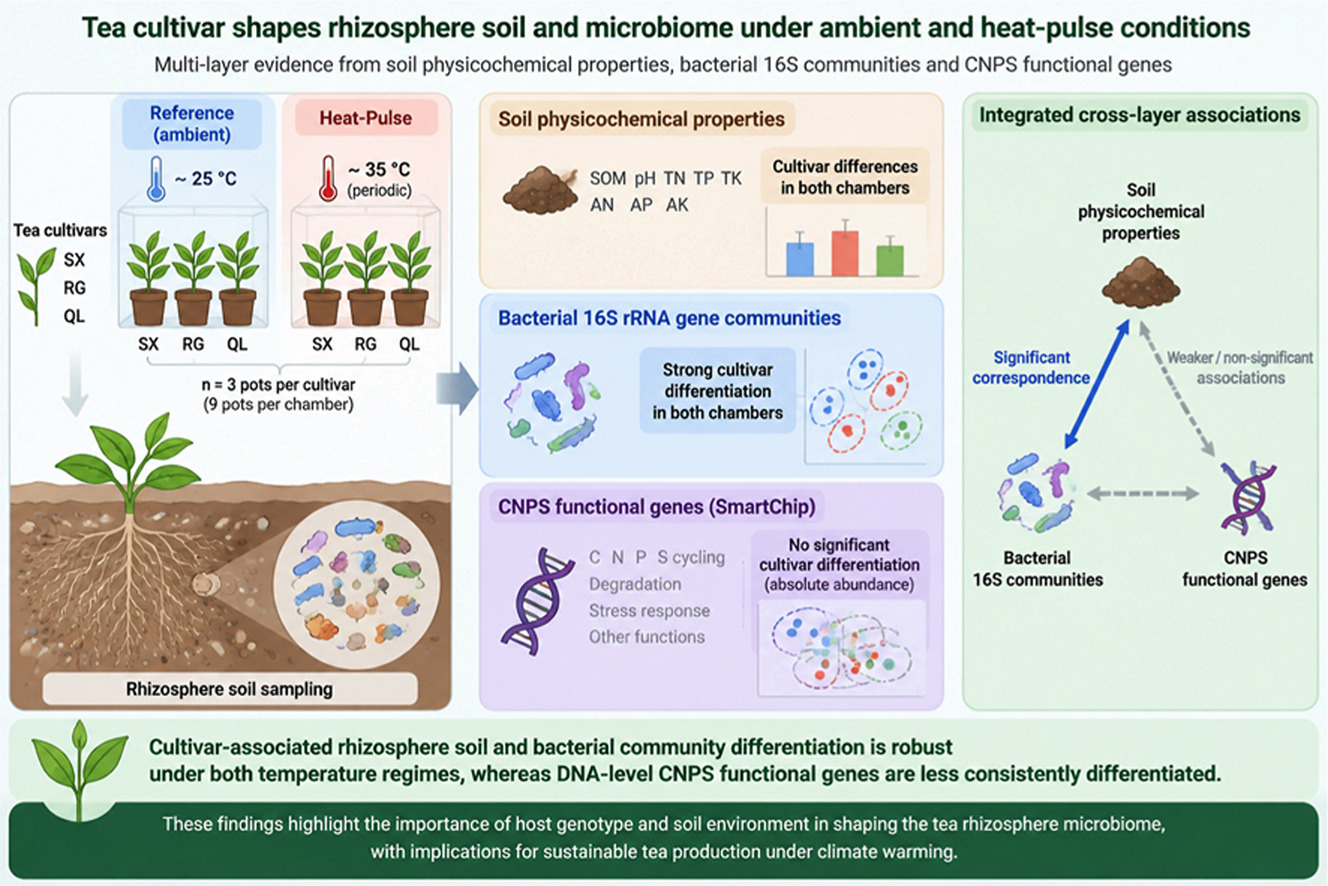
Recurrent daytime heat can modify plant–soil–microbe relationships, but cultivar-associated rhizosphere responses remain poorly resolved in perennial tea. We compared three Wuyi rock tea cultivars — Shuixian (SX), Rougui (RG) and Qilan (QL) — under two 30-d chamber programs that differed during a 5-h midday period (21 °C in the Reference chamber and 40 °C in the Heat-Pulse chamber). Because each program was implemented in one dedicated chamber, replicated inference was restricted to cultivar differences within chambers; between-program contrasts were descriptive. Rhizosphere soil chemistry, bacterial 16S rRNA amplicon profiles and CNPS functional-gene abundance were quantified from 18 pot-level samples. Six of eight soil variables showed FDR-significant cultivar effects in each chamber. Bacterial composition was strongly cultivar-differentiated (PERMANOVA R2 = 0.640, P = 0.004 in Reference; R2 = 0.712, P = 0.005 in Heat-Pulse). In contrast, finalized absolute CNPS profiles were not significantly differentiated among cultivars in either chamber, although a 16S-normalized sensitivity representation was significant in Reference only. Across all samples, soil and bacterial dissimilarities covaried (Mantel r = 0.411, FDR-adjusted P = 0.0003), whereas global associations involving CNPS were not significant after FDR correction. Partial db-RDA identified TN and AP as conditional correlates of bacterial composition, with no FDR-significant soil variable for CNPS. Thus, cultivar-associated differentiation was robust for rhizosphere soil and bacterial communities but weaker and abundance-representation-sensitive at the DNA-level functional-gene layer.



 Address: No. 31 Fukang Road, Nankai District,Tianjin, 300191, P.R. China
 Website: https://aepi.caas.cn/en/
 Email: hbskjc@163.com