Nanotechnology-based strategies for saline–alkaline soil management in arid agroecosystems: From mechanisms to field application and commercialization
, , , , ,
a College of Life Science and Technology, Tarim University, Alar, 843300, China
b Xinjiang Production and Construction Corps Key Laboratory of Protection and Utilization of Biological Resources in Tarim Basin, Alar, 843300, China
c Department of Biosciences, COMSATS University Islamabad (CUI), Islamabad, Pakistan
Abstract
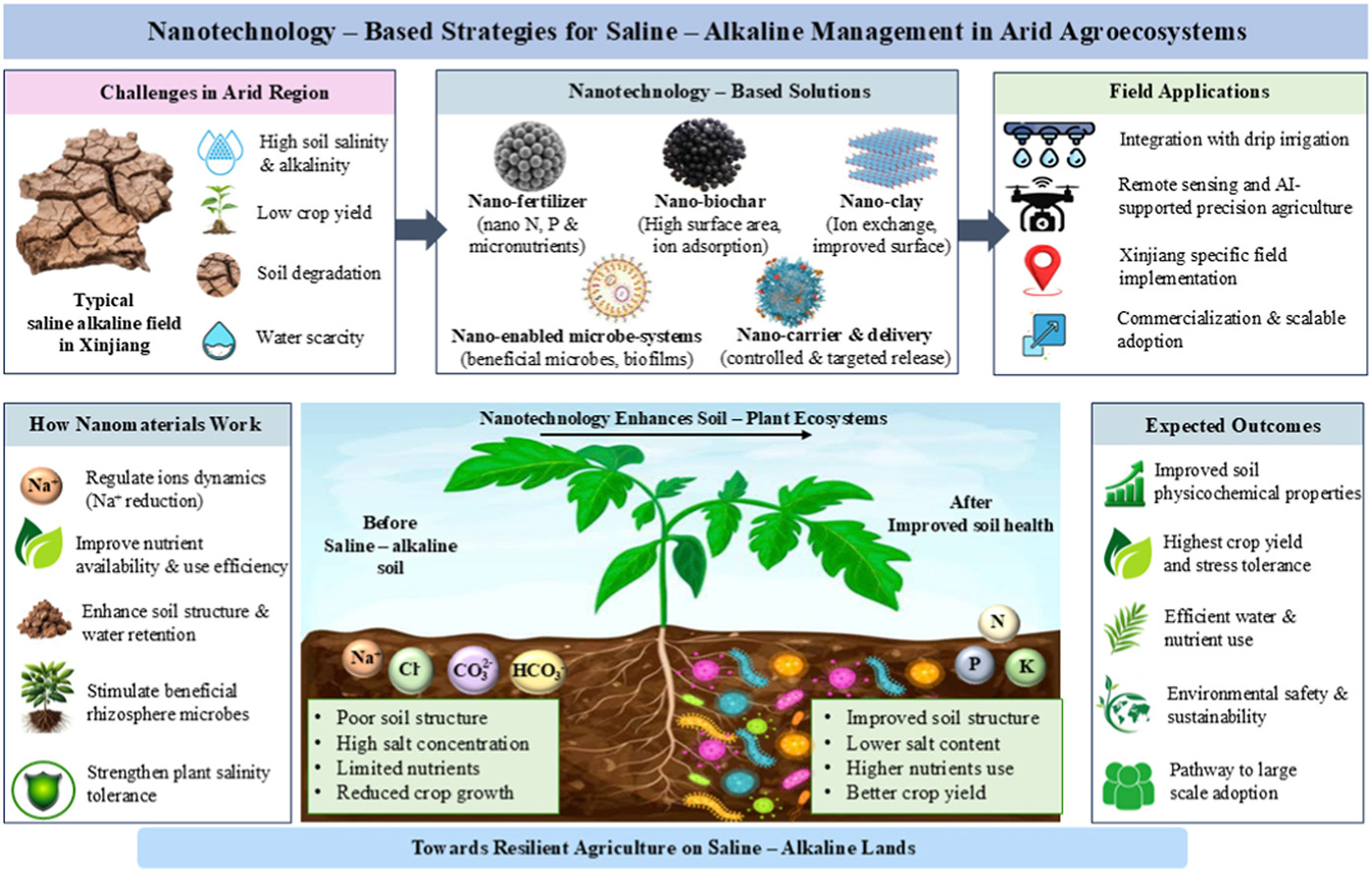
Saline–alkaline soils severely limit agricultural productivity in arid and semi-arid regions, particularly in Xinjiang, China, where intensive irrigation and extreme climatic conditions accelerate soil salinization and degradation. Conventional reclamation methods, including gypsum application, leaching, drainage, and organic amendments, are partially effective but are limited by high water demand, slow recovery rates, and low efficiency under heterogeneous field conditions. Nanotechnology has recently emerged as a complementary strategy, enabling precise regulation of ion dynamics, targeted nutrient delivery, soil structural improvement, and plant stress mitigation across multiple biological scales. This review synthesizes recent advances in nanotechnology-based saline–alkaline soil improvement, with emphasis on mechanistic understanding, comparative performance, and field-scale applicability. Distinctively, this review links multi-scale mechanisms with Xinjiang-specific field constraints, technology readiness, commercialization, and environmental safety. Key nanomaterials including nano-fertilizers, nano-biochar, nano-clays, and nano-enabled microbial systems are evaluated for their roles in enhancing soil physicochemical properties, improving nutrient use efficiency, and strengthening plant tolerance to salinity stress. The importance of multi-scale interactions across soil, rhizosphere, and cellular levels, highlighted by emerging evidence, positions nanomaterials as multifunctional regulators within complex agroecosystems. Beyond laboratory findings, this review examines field applications in Xinjiang, particularly integration with drip irrigation, remote sensing, and AI-supported precision agriculture. Commercial readiness, adoption barriers, and regulatory considerations are also critically assessed. Overall, nano-enabled inputs offer a scalable pathway for saline–alkaline land improvement when integrated with established reclamation practices; however, multiseason field evidence in Xinjiang remains limited, and field variability, economic feasibility, ecological risks, and large-scale deployment require validation.



 Address: No. 31 Fukang Road, Nankai District,Tianjin, 300191, P.R. China
 Website: https://aepi.caas.cn/en/
 Email: hbskjc@163.com