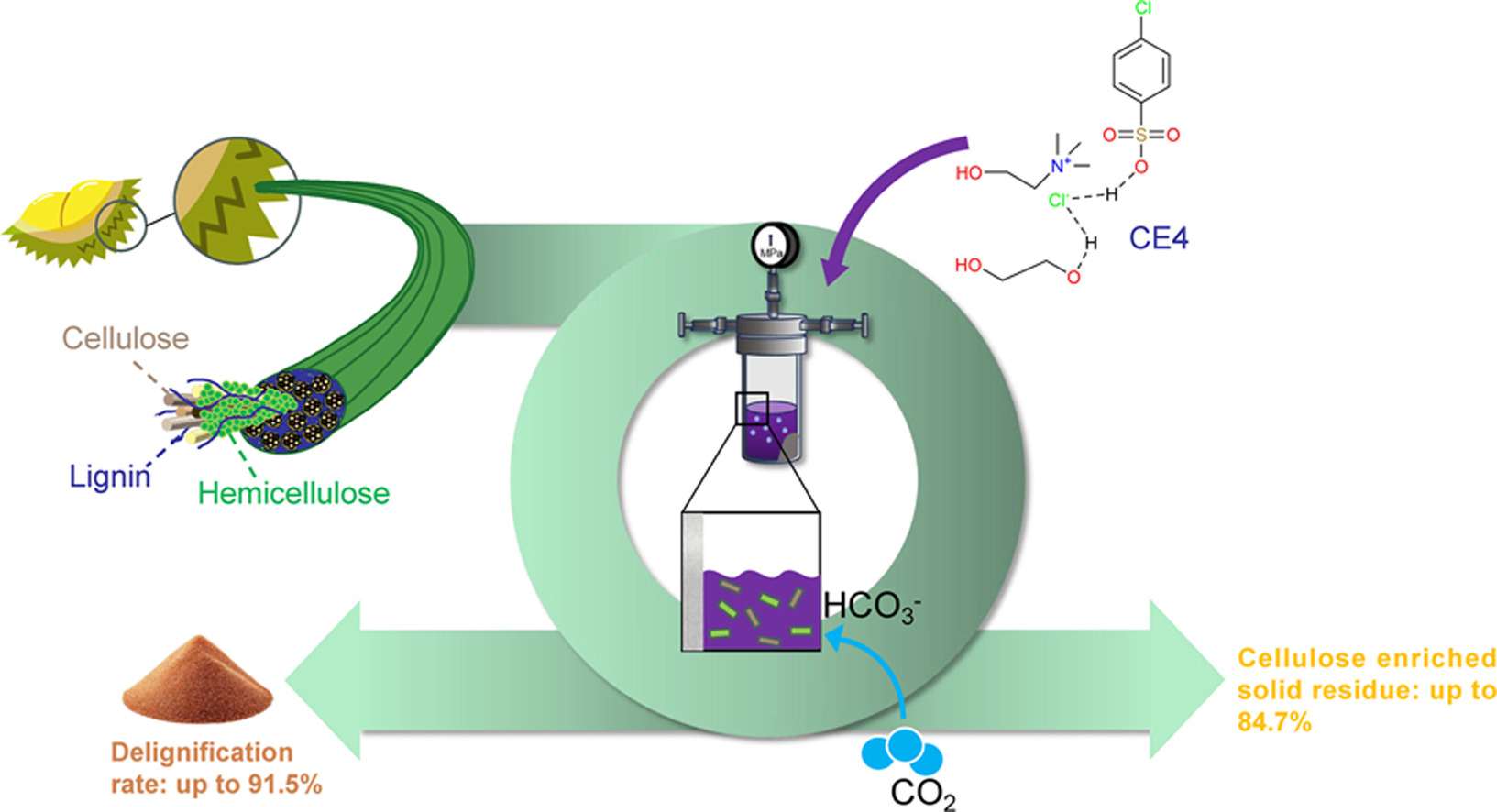
One-step green separation of durian husk lignocellulose using polyol-based ternary deep eutectic solvent under subcritical carbon dioxide
, , , ,
a Agro-Environmental Protection Institute, Ministry of Agriculture and Rural Affairs, Tianjin, 300191, China
b Faculty of Food Science and Technology, Universiti Putra Malaysia, Serdang, Selangor, 43400, Malaysia
c Supercritical Fluid Centre (SFC), Faculty of Food Science and Technology, Universiti Putra Malaysia, Serdang, Selangor, 43400, Malaysia
Abstract
Durian husk is rich in lignocellulose and represents a promising target for recycling and value-added utilization. However, the complex structure of lignin and its protective association with carbohydrates pose significant challenges for efficient component separation. Conventional chemical methods are often operationally complex, energy-intensive, and environmentally unfriendly. In this study, a one-step green separation method was developed using a subcritical carbon dioxide (CO2) environment in combination with an alcohol-based ternary deep eutectic solvent (DES) composed of choline chloride, ethylene glycol, and 4-chlorobenzenesulfonic acid. This method achieved a delignification rate of up to 91.5% and a cellulose retention rate of 84.7% under mild conditions ranging from 60 °C to 90 °C and varying CO2 pressures. The separation parameters influenced the crystallinity index, hydrogen bonding interactions, and lignin unit distribution in the cellulose-enriched fraction. Moreover, the incorporation of subcritical CO2 enhanced the acidity and proton donation capacity, thereby improving reaction efficiency. In summary, this study presents a mild, efficient, and environmentally friendly strategy for the selective separation of lignocellulose from natural biomass.



 Address: No. 31 Fukang Road, Nankai District,Tianjin, 300191, P.R. China
 Website: https://aepi.caas.cn/en/
 Email: hbskjc@163.com