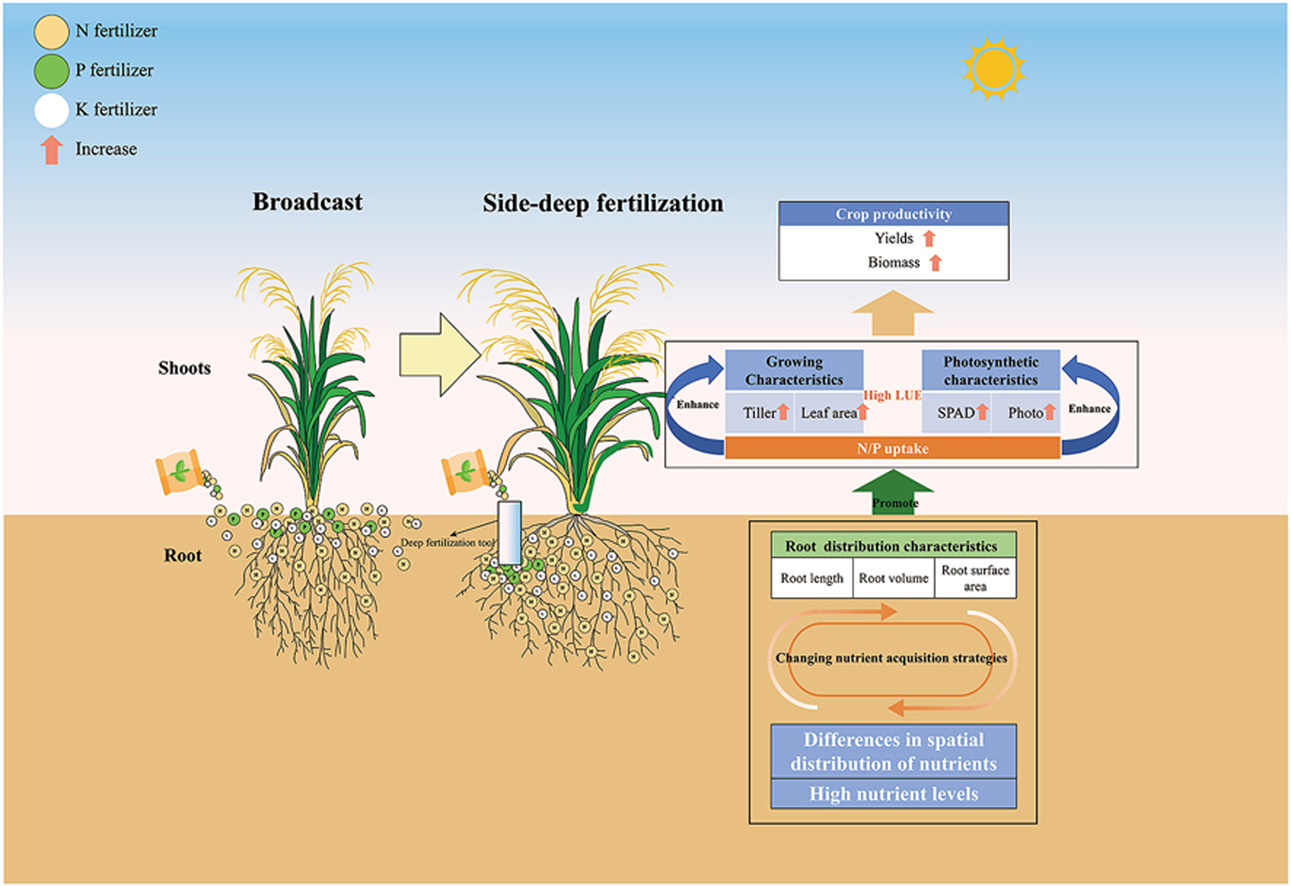
Side-depth fertilization modified rice growth strategy to enhance grain yield by optimizing soil nutrient conditions
, , , , , , , , , ,
a College of Resources, Hunan Agricultural University, Changsha, 410128, PR China
b Hunan Provincial Key Laboratory of Farmland Pollution Control and Agricultural Resources Use, Hunan Provincial Key Laboratory of Nutrition in Common University, National Engineering Research Center for Efficient Utilization of Soil and Fertilizer Resources, Changsha, 410128, PR China
Abstract
Side-depth fertilization (SDF) is a critical strategy to boost fertilizer use efficiency and crop production. Yet, the growth strategies of rice in response to soil nutrient changes brought by SDF have been rarely reported. To enrich the rice SDF technology, this study set up four treatments: no fertilization (CK), surface fertilization (D0), 5 cm side-deep application (D5), and 10 cm side-deep application (D10). The study compared the spatial distribution characteristics of fertilizer nutrients and rice roots in the soil, as well as photosynthetic and growth traits, yield, and fertilizer use efficiency across different treatments. The results indicated that, in comparison to D0, SDF significantly altered the distribution of soil nitrogen (N) and phosphorus (P), enhancing their levels within the tillage layer. For root systems, SDF somewhat reduced the distribution of deep roots, with root weight and root-shoot ratio decreasing by 0.2%–28.2% and 5.0%–15.9%, respectively. For the canopy, SDF increased tillering by 8.42%–25.6%, net photosynthetic rate by 0.18%–16.86%. Strategic adjustments to the root systems and canopy under SDF treatment promote the accumulation of dry matter and the formation of yield in rice. Compared with D0, SDF increased the biomass by 10.6%–36.3%, and yields by 5.77%–21.35%. Additionally, it enhanced N recovery efficiency (NRE) by 20.0%–36.7% and P recovery efficiency (PRE) by 0.01%–22.0%. However, there was no significant difference in above-ground biomass, NRE, and PRE between the D10 and D5. But, compared with D5, D10 exhibited stronger nutrient retention, accompanied by lower root distribution in deeper soil layers and greater potential for fertilizer reduction.



 Address: No. 31 Fukang Road, Nankai District,Tianjin, 300191, P.R. China
 Website: https://aepi.caas.cn/en/
 Email: hbskjc@163.com