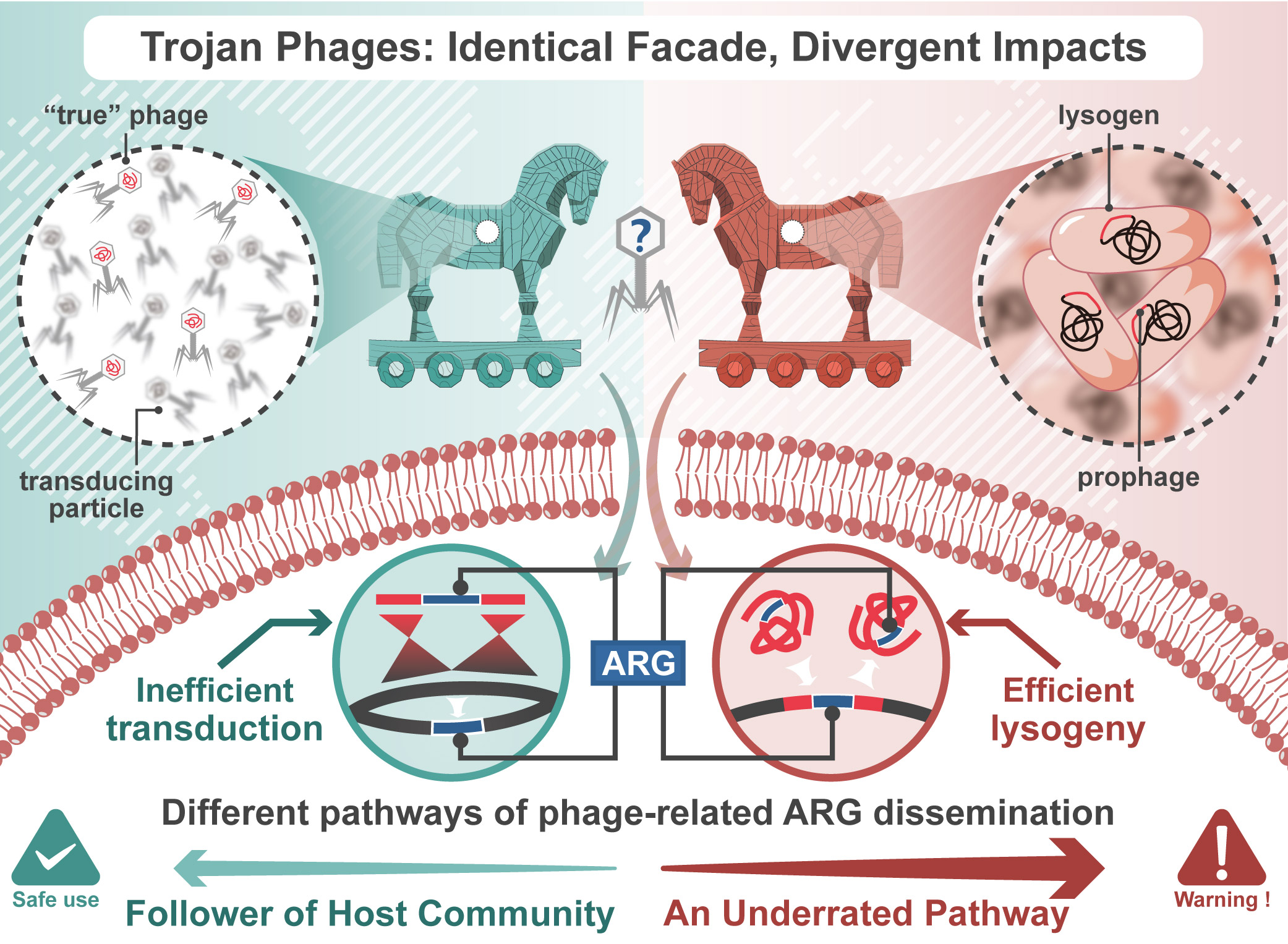
Trojan phages: Distinguishing lysogeny from transduction in phage-involved ARG dissemination
, , , ,
Fujian Provincial Key Laboratory of Soil Environmental Health and Regulation, College of Resources and Environment, Fujian Agriculture and Forestry University, Fuzhou, 350002, China
Abstract
Despite evidence that questions the scale of phage contributions to antibiotic resistance gene (ARG) circulation, phages are increasingly recognized as key facilitators of horizontal gene transfer (HGT) within microbial communities. This recognition prompts a reevaluation of their dual roles as therapeutic agents and vectors of resistance, particularly in contexts where antimicrobial resistance (AMR) poses a significant global health threat. Accordingly, this review first elucidates phage-mediated HGT mechanisms, extending beyond classical transduction to encompass lysogeny and related processes. It further examines the potential for virus-like particles and phage-derived fractions to harbor ARGs across diverse environments (aquatic, terrestrial, and host-associated), while emphasizing the limited efficiency of transduction in ARG dissemination. Moreover, this review explores the prevalence of temperate phage infections and their capacity to mobilize ARGs, highlighting lysogeny as an underappreciated pathway for ARG spread. Finally, it underscores the urgency of addressing research gaps and misconceptions, advocating a multidisciplinary approach to harness phage biology in mitigating AMR. This synthesis of phage-mediated HGT mechanisms and their ecological and clinical implications provides a comprehensive perspective, emphasizing the need for informed strategies to manage ARG dissemination.



 Address: No. 31 Fukang Road, Nankai District,Tianjin, 300191, P.R. China
 Website: https://aepi.caas.cn/en/
 Email: hbskjc@163.com