Benchmark-aware Ensemble Kalman Filter assimilation of soil moisture and nitrate for water conditioned leaching risk diagnosis in semi-arid maize
,
a Nuclear Chemistry and Environmental Research Centre, National Nuclear Research Institute (NNRI), Ghana Atomic Energy Commission (GAEC), Box LG 80, Legon, Accra, Ghana
b Department of Nuclear Science and Applications, School of Nuclear and Allied Sciences, University of Ghana, Atomic-Kwabenya, Accra, Ghana
Abstract
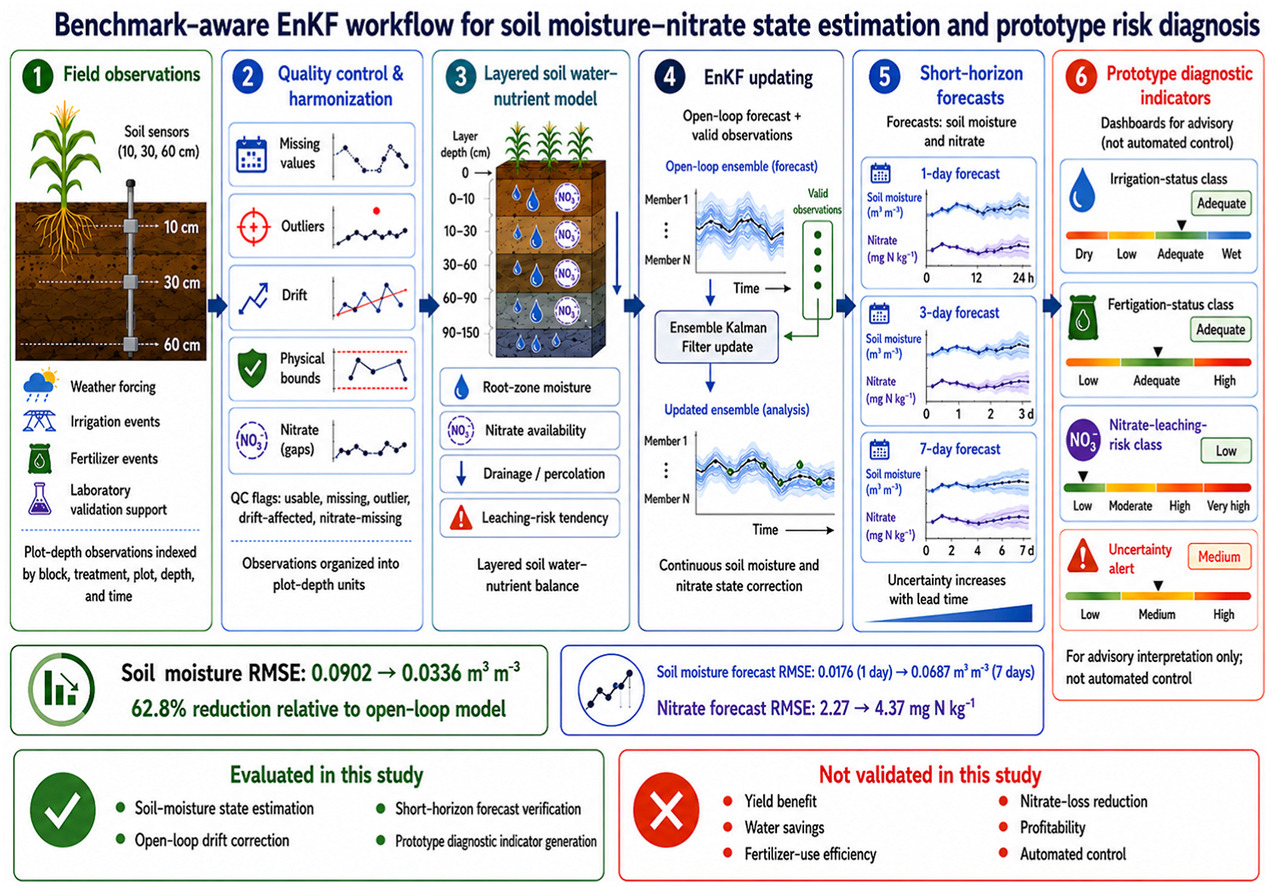
Root zone water redistribution and nitrate mobility are difficult to diagnose in semi-arid agricultural profiles because point observations are noisy and temporally uneven, while open-loop process models may drift after rainfall, irrigation and fertilizer events. This study presents a benchmark-aware, observation-role-audited Ensemble Kalman Filter (EnKF) workflow for plot-depth soil moisture and nitrate state estimation in a maize field at Lawra, Upper West Region, Ghana, from 1 June to 13 September 2025. Calibrated observations at 10, 30 and 60 cm were integrated with weather forcing, irrigation and fertilizer event logs, management records and laboratory nitrate support within a layered soil-water-nutrient model. The contribution is not a new Kalman-filter algorithm, but a reproducible field-scale protocol combining asynchronous moisture-nitrate updating, calibration-update-validation role separation, benchmark-aware interpretation and water-conditioned nitrate-risk diagnosis. Relative to the open-loop model, EnKF assimilation reduced full-period soil moisture RMSE from 0.0902 to 0.0336 m3 m−3 and MAE from 0.0801 to 0.0297 m3 m−3; validation-period RMSE declined from 0.1038 to 0.0386 m3 m−3. Sensitivity testing showed that soil moisture RMSE remained below the open-loop value across tested ensemble size, covariance, inflation and update-frequency settings, with greatest deterioration under daily rather than hourly updating. Forecast error increased with lead time: moisture RMSE rose from 0.0176 m3 m−3 at 1 day to 0.0687 m3 m−3 at 7 days, while nitrate RMSE rose from 2.27 to 4.37 mg N kg−1. Because aggregate NSE values remained negative, the workflow is presented as drift correction and short-horizon diagnostic state estimation, not proof of reduced nitrate loss or agronomic improvement.



 Address: No. 31 Fukang Road, Nankai District,Tianjin, 300191, P.R. China
 Website: https://aepi.caas.cn/en/
 Email: hbskjc@163.com