Soil acidification promotes bacterial wilt: Meta-analysis reveals key modulators and management strategies via pH and available phosphorus
, , , , , ,
a College of Resources and Environment, Shanxi Agricultural University, Taigu, Shanxi, 030800, China
b Soil Health Laboratory of Shanxi Province, Institute of Eco-environment and Industrial Technology, Shanxi Agricultural University, Taiyuan, Shanxi, 030031, China
c State Key Laboratory of Efficient Utilization of Arable Land in China, Institute of Agricultural Resources and Regional Planning, Chinese Academy of Agricultural Sciences, Beijing, 100081, China
Abstract
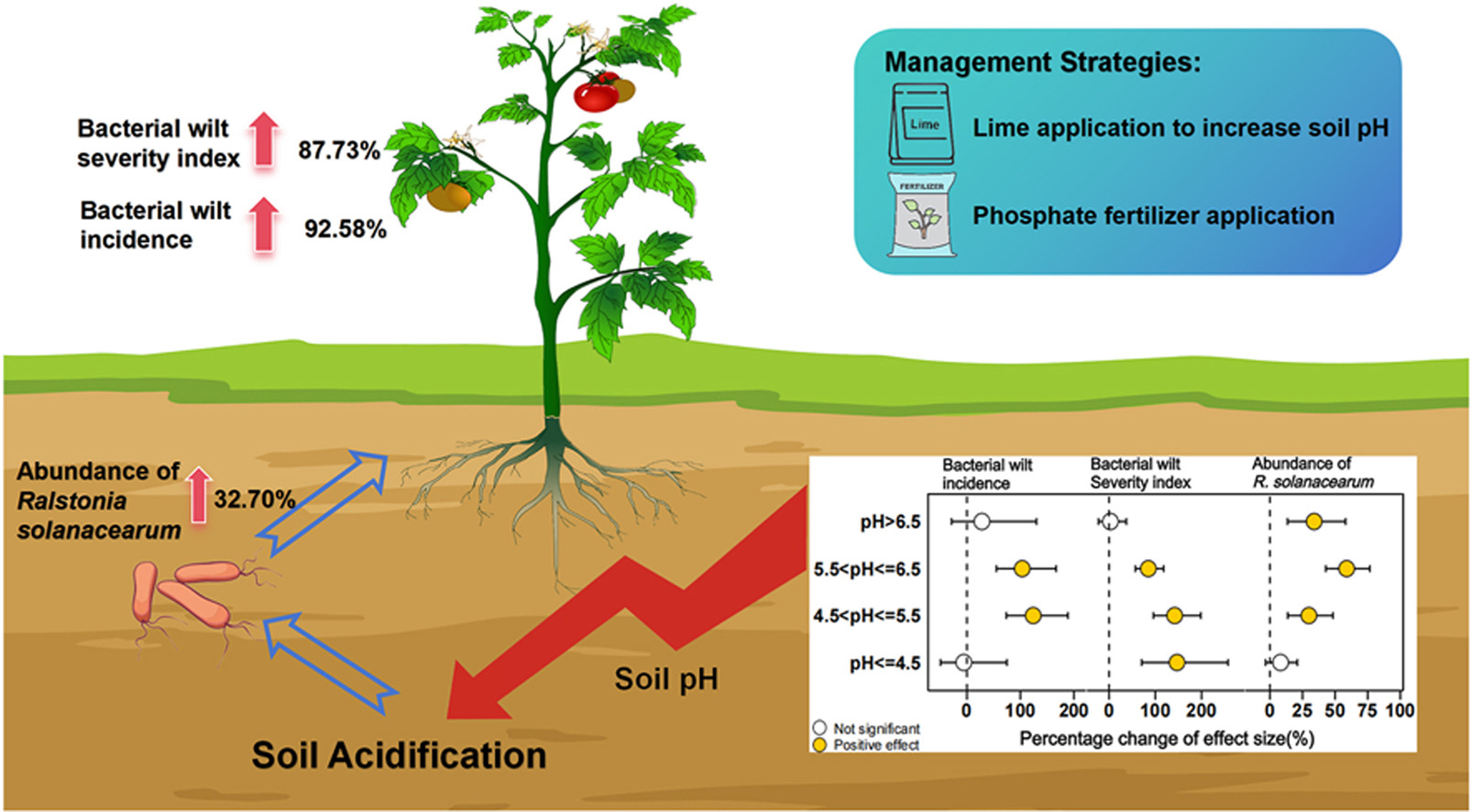
Soil acidification disrupts microbial ecosystems and increases crop susceptibility to bacterial wilt, posing a significant threat to global agricultural sustainability. While its influence on Ralstonia solanacearum-induced bacterial wilt has been documented, studies report inconsistent effects on disease incidence, severity, and pathogen abundance, with the interactive roles of environmental and edaphic factors remaining poorly understood. To resolve these discrepancies, we conducted a comprehensive meta-analysis of 317 studies across Asia, Africa, Americas, covering major Ralstonia-host crops (tomato, potato, tobacco, peanut and sesame). Our results demonstrated that soil acidification significantly increased bacterial wilt incidence (1.93-fold), disease severity (1.88-fold), and R. solanacearum abundance (1.33-fold). Key moderators included precipitation and temperature which attenuated disease severity at higher levels, and soil available phosphorus, which showed strong negative correlations with both disease incidence (r = −0.40) and pathogen abundance (r = −0.68). These findings suggest two actionable management strategies to reduce bacterial wilt risk: (1) maintaining optimal soil pH (> 6.5) and (2) targeted phosphorus fertilization to counter acidification-driven pathogen proliferation. By elucidating soil chemistry-environmental-pathogen interactions, this study provides a robust foundation for sustainable soil health strategies and bacterial wilt mitigation.



 Address: No. 31 Fukang Road, Nankai District,Tianjin, 300191, P.R. China
 Website: https://aepi.caas.cn/en/
 Email: hbskjc@163.com