Predicting maximum adsorption capacity of antibiotics on biochar: An end-to-end approach based on saturated and unsaturated adsorption isotherms
, , , , , , , , , ,
a Key Laboratory of Soil Environment and Pollution Remediation, Institute of Soil Science, Chinese Academy of Sciences, Nanjing 210008, China
b University of Chinese Academy of Sciences, Beijing, 100049, China
c School of Earth and Environment, Anhui University of Science and Technology, Huainan 232001, China
d School of Environmental and Chemical Engineering, Nanchang Hangkong University, Nanchang, 330063, China
e College of Environmental Science and Engineering, Yangzhou University, Yangzhou, 225009, China
Abstract
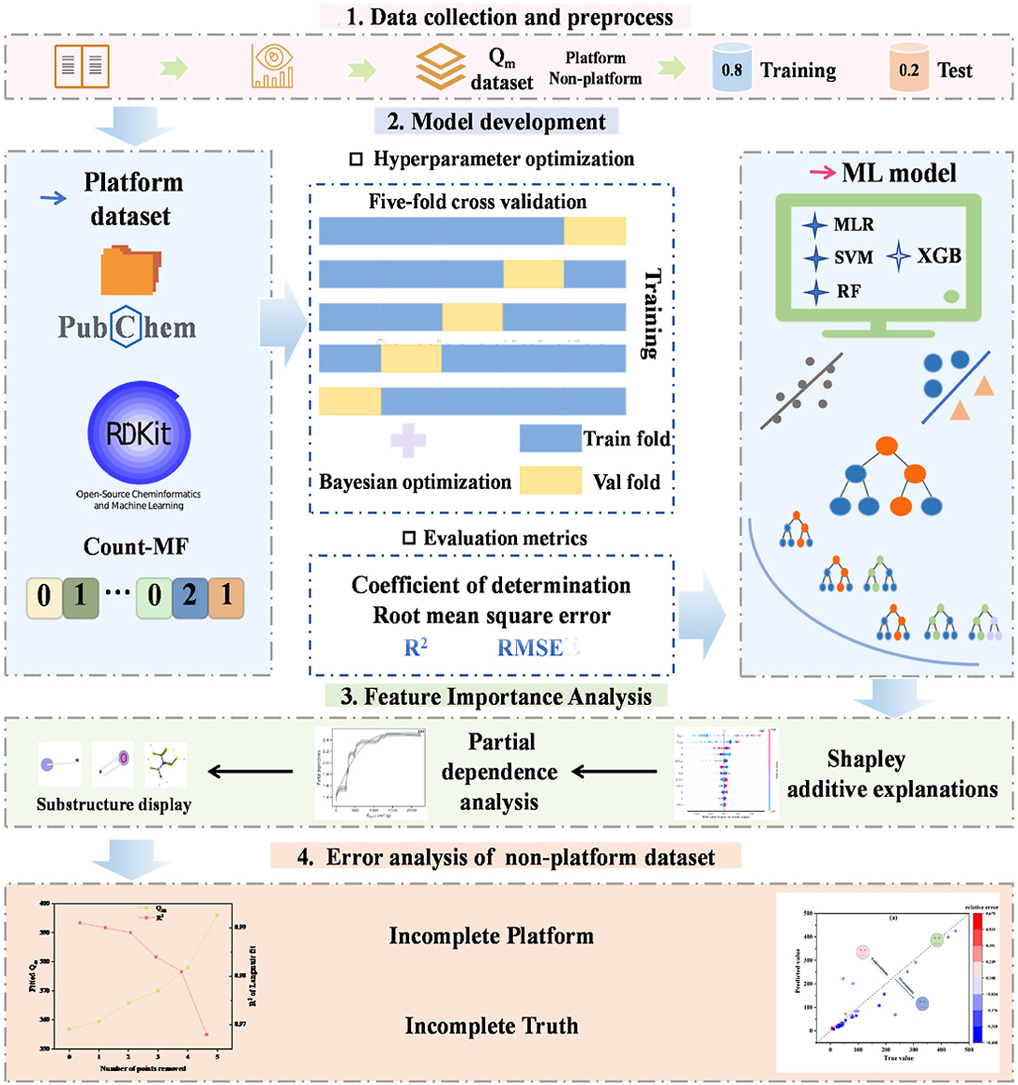
Biochar is a promising adsorbent for antibiotics removal due to its high specific surface area and tunable properties. The maximum adsorption capacity (Qm), derived from Langmuir model fitting, is widely used as a key performance indicator. However, it often suffers from systematic bias when experiments fail to reach true equilibrium. Analysis of a curated dataset of 250 experimental isotherms revealed that 36 cases failed to reach the saturation plateau. To address this issue, we constructed end-to-end machine learning (ML) models based on the saturated isotherm dataset of 214 experimental isotherms. Among various algorithms, extreme gradient boosting regression tree (XGB) achieved the best predictive accuracy for Qm, with coefficient of determination (R2) of 0.89 and root mean square error (RMSE) of 0.23. Integrating Shapley Additive Explanations (SHAP) and Partial Dependence Plots (PDP) analyses confirmed that specific surface area and total pore volume of biochar played pivotal roles in governing Qm. Validation on synthetic unsaturated isotherms created by truncating saturated ones showed Langmuir Qm overestimated by 0.14%–32.23%. Applying the trained XGB model to the real unsaturated cases correctly recognized the overestimation of 5.31%–45.21% by Langmuir Qm. These findings highlight that premature termination of isotherm experiments introduces significant near-plateau bias, impairing Langmuir Qm fitting, while our ML model effectively compensates for this incomplete-plateaus bias, enabling reliable comparison of biochar performance. A graphical online prediction tool integrating the accurate and interpretable machine learning models was developed to facilitate the optimization and practical application of biochar for antibiotics removal.



 Address: No. 31 Fukang Road, Nankai District,Tianjin, 300191, P.R. China
 Website: https://aepi.caas.cn/en/
 Email: hbskjc@163.com