A framework for winter wheat growth stage identification using UAV multispectral imagery via feature optimization and deep learning
, , , ,
a School of Mining and Geomatics Engineering, Hebei University of Engineering, Handan, Hebei, 056038, China
b State Key Laboratory of Geographic Information Science and Technology, Chinese Academy of Sciences, Beijing, 100101, China
c State Key Laboratory of Efficient Utilization of Arid and Semi-Arid Arable Land in Northern China, Institute of Agricultural Resources and Regional Planning, Chinese Academy of Agricultural Sciences, Beijing, 100081, China
Abstract
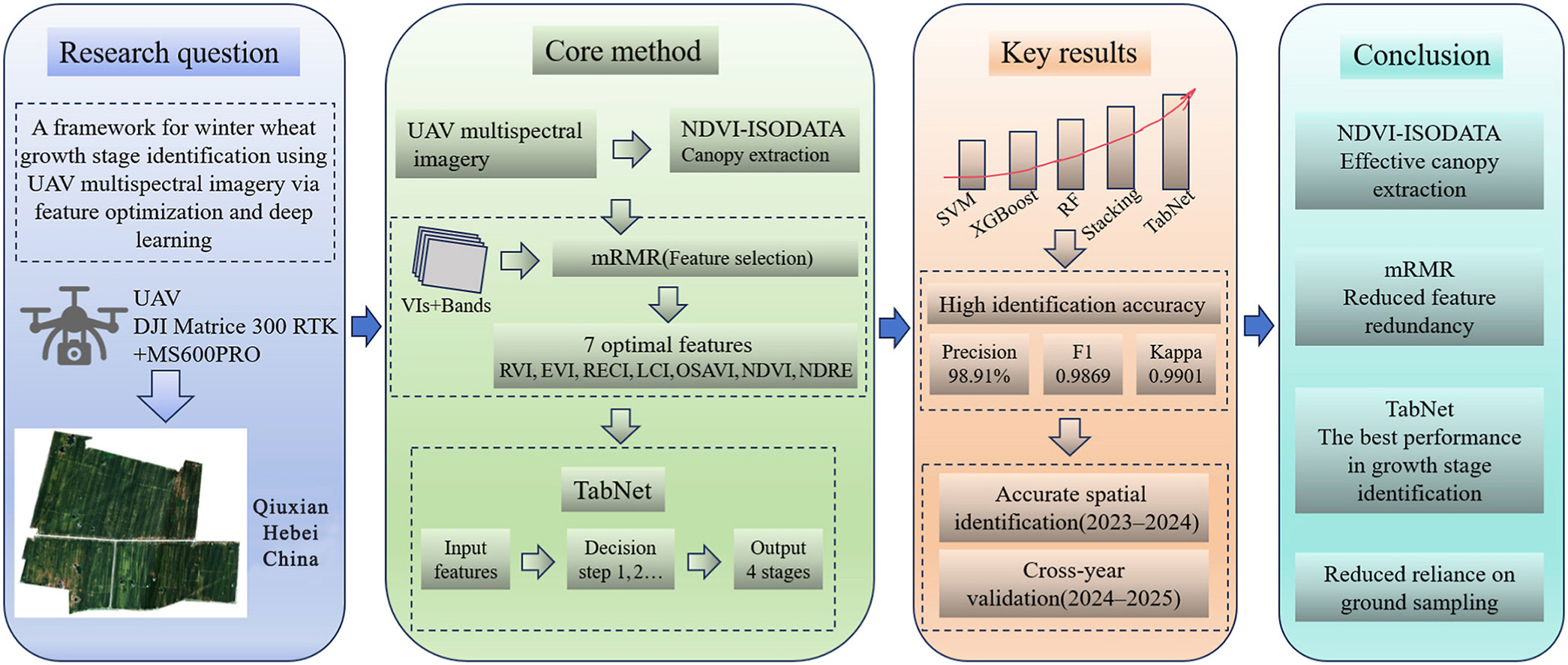
Accurate identification of winter wheat growth stages at the field scale is crucial for optimizing agronomic management and improving agricultural production efficiency. In recent years, Unmanned Aerial Vehicle (UAV)-based remote sensing has provided new opportunities for fine-scale crop monitoring due to its high spatial resolution, flexible data acquisition capability, and accumulation of historical data covering different crop growth stages. However, existing methods still face challenges associated with high-dimensional and redundant features, which may limit model generalization and practical applicability. In this context, the present study proposed a feature optimization and deep learning-based method for winter wheat growth stage identification using centimeter-level UAV multispectral imagery. The spectral and vegetation index features were extracted from UAV images collected during the 2023–2024 growing seasons. Subsequently, NDVI-ISODATA and mRMR were applied for canopy extraction and feature selection, respectively. Machine learning algorithms, the Stacking ensemble technique, and the TabNet deep learning architecture were developed and evaluated. In addition, independent spatial validation was performed using the 2024–2025 datasets. The results demonstrated the effectiveness of NDVI-ISODATA in extracting canopy information. Furthermore, mRMR reduced feature redundancy and enhanced model discrimination. TabNet achieved the best performance, reaching overall accuracy, F1 score, and Kappa coefficient values of 98.91%, 0.9869, and 0.9901, respectively. The proposed framework enabled accurate winter wheat growth stage identification, providing an effective solution for crop monitoring and management at the field scale.



 Address: No. 31 Fukang Road, Nankai District,Tianjin, 300191, P.R. China
 Website: https://aepi.caas.cn/en/
 Email: hbskjc@163.com