[Glu][H2PO4] modulates the absorption and translocation of cadmium and arsenic in rice
, , , , , , , , ,
a Key Laboratory of Original Agro-Environmental Pollution Prevention and Control, Ministry of Agriculture and Rural Affairs, Agro-Environmental Protection Institute, Tianjin, 300191, China
b Hubei Key Laboratory of Biomass Resource Chemistry and Environmental Biotechnology, School of Resource and Environmental Sciences, Wuhan University, Wuhan, 430079, China
c Université Clermont Auvergne, CNRS, Institut de Chimie de Clermont-Ferrand, Clermont-Ferrand, F-63000, France
d Università degli Studi di Torino, Dipartimento di Chimica, Via P. Giuria 5, Torino, 10125, Italy
Abstract
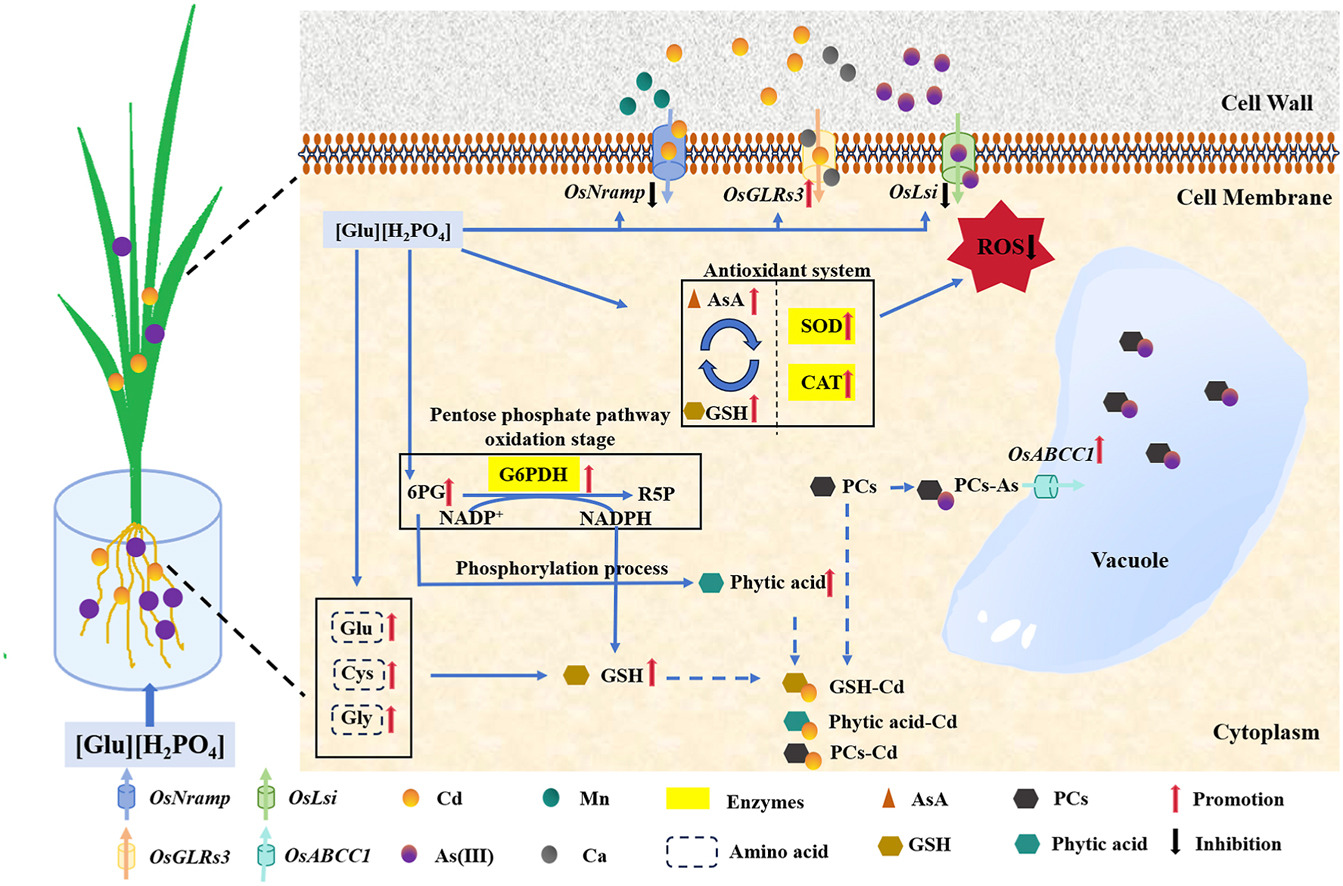
The remediation of paddy fields contaminated by cadmium (Cd) and arsenic (As) is a global concern. In the present study, the field experiments were conducted to evaluate the effectiveness of foliar-applied [Glu][H2PO4] (Glu = glutamate) in reducing Cd and As accumulation in rice grains, while a hydroponic experiment under controlled Cd/As stress was used to examine whether this response was associated with changes in subcellular distribution and selected physiological indicators. Field experiments showed that foliar spraying with 0.2–1.5 mmol/L [Glu][H2PO4] reduced Cd accumulation by 6%–27% and 6%–26%, and As accumulation by 8%–24% and 8%–30% in early and late rice, respectively. In the hydroponic experiments, 1.5 mmol/L [Glu][H2PO4] was associated with markedly lower Cd and As contents in both roots and shoots. This treatment also coincided with a greater proportion of Cd in the cell-wall fraction, a greater proportion of As in the soluble fraction, and changes in selected chelation-related, antioxidant-related, and transporter-related indicators. Together, these results support the potential of foliar-applied [Glu][H2PO4] as a mitigation strategy for Cd/As-contaminated rice production and suggest that altered intracellular partitioning and detoxification-related responses may contribute to the reduced accumulation observed. However, the route-specific mechanism linking foliar application in the field to the responses observed in the seedling assay remains to be further clarified.



 Address: No. 31 Fukang Road, Nankai District,Tianjin, 300191, P.R. China
 Website: https://aepi.caas.cn/en/
 Email: hbskjc@163.com