a Key Laboratory of Pollution Processes and Environmental Criteria (Ministry of Education), Carbon Neutrality Interdisciplinary Science Center/College of Environmental Science and Engineering, Nankai University, Tianjin, 300350, China
b School of Agriculture and Biology, Shanghai Jiao Tong University, Shanghai, 200240, China
c Centre for Planetary Health and Food Security, School of Environment and Science, Griffith University, Nathan, Brisbane, QLD, 4111, Australia
d College of Engineering and Physical Sciences, University of Wyoming, Laramie, WY, 82071, USA
e Biochemistry, College of Science, University of Jeddah, Jeddah, Saudi Arabia
Abstract
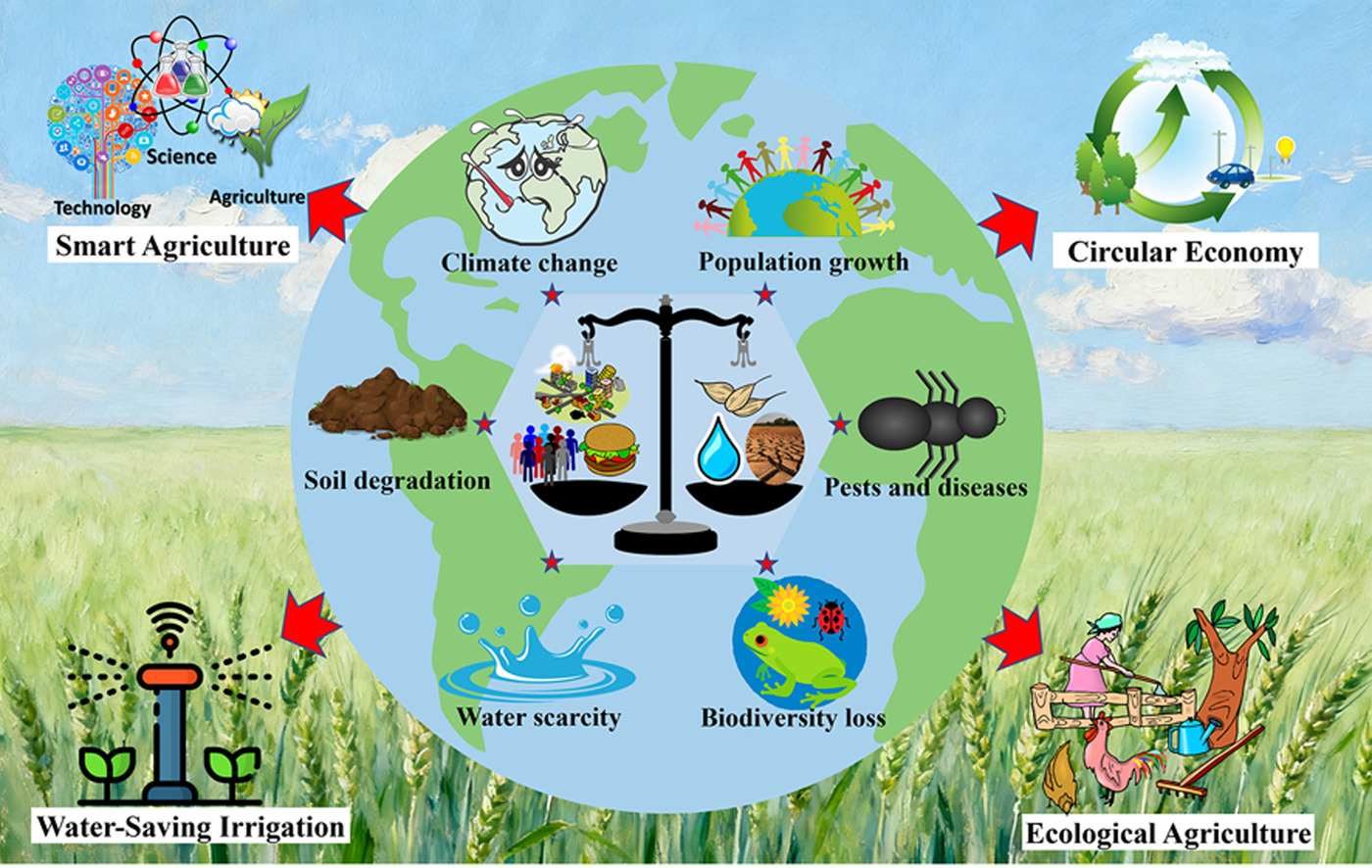
Agriculture and agricultural environment constitute the fundamental basis for human subsistence and economic progress globally. However, geographic disparities, uneven precipitation distribution, and unequal technological development drive significant regional divergences in agricultural trajectories. Consequently, global agriculture is stratified into 10 distinct zones, characterized by varying dominant crop systems, dietary patterns, and rates of innovation adoption. These subregions collectively confront escalating environmental pressures—notably climate change, with extreme weather events, widespread soil degradation, and diminishing biodiversity, as well as critical resource depletion exacerbated by pollution from intensive practices (e.g., fertilizer overuse, which contributes to greenhouse gas emissions). These converging crises threaten global food security and ecological stability, pushing agricultural systems toward environmental tipping points. This review analyzes the distinct development models and acute environmental challenges confronting each of the ten agricultural zones. It synthesizes the underlying global pressures driving adverse environmental transformations in agriculture. To counter these threats, integrated solutions are imperative. These include adopting sustainable technologies such as slow-release fertilizers to reduce pollution while enhancing soil health, deploying precision agriculture to optimize resource allocation, and shifting to climate-resilient agronomic practices that buffer against extreme weather variability. Future food security necessitates embedding sustainability into agricultural development strategies through enabling policies, technological innovation, and global cooperation.



 Address: No. 31 Fukang Road, Nankai District,Tianjin, 300191, P.R. China
 Website: https://aepi.caas.cn/en/
 Email: hbskjc@163.com